Reviews
Part of Does the paper damage record actually point to water more than workmanship?
A beginner examination kit: six cheap tools for looking, not making
Beginner kit for examining paper objects in 2027: six inexpensive items for looking rather than making, how to tell printing processes apart under a loupe.
What to take away
- This is a kit for looking at paper objects, not for making them.
- Six items, none expensive, and two of them are pieces of paper.
- Identifying what a thing is made of comes before deciding what to do with it.
- Write what you see before you decide what it means.
The kit
| Item | Use | Note |
|---|---|---|
| Loupe or linen tester | Reading a printed surface | Ten times is plenty |
| Raking light | Revealing texture and repairs | A phone torch held low works |
| Steel rule in millimeters | Measuring squares and margins | Not a tape measure |
| Number two pencil | Recording, marking nothing | Never a pen near the object |
| Blank sheets and blotters | Supporting and interleaving | Consumable |
| A dated notebook | The actual output | The only permanent item |
Nothing here needs a specialist supplier. The whole kit fits in a shoebox and costs less than a single bone folder, and the notebook is the part that keeps returning value years later.
Identify the process before judging the object
A loupe mostly shows which process made the marks; the Florida State University Libraries guide to printmaking and typography resources in special collections is organized exactly that way.
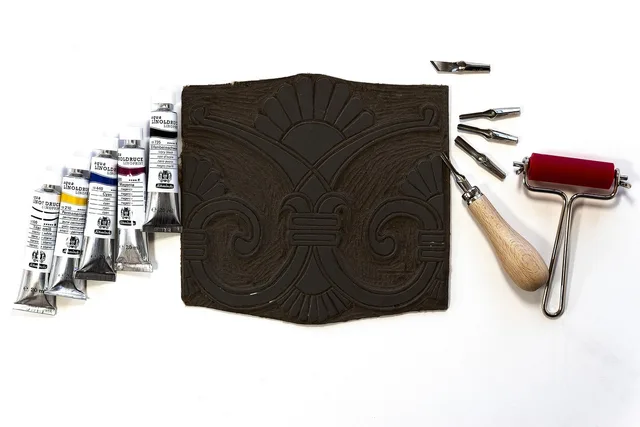
Its sections separate intaglio and etching, relief in wood engraving and linocut, screenprinting, lithography and letterpress. They also cover digital printing and offset, broadsides, ephemera, specimens and artists' books.
Learning to tell those apart under magnification is the single most useful skill in this article. A plate mark, an ink squash at the edge of a letter, a halftone dot pattern and a flat lithographic tone all look different at ten times magnification and identical at arm's length.
Dates narrow the possibilities
When a paper object carries a photographic image, the process narrows the date.
The Park Service publishes a chronology of photographic processes. This chart shows approximate dates of use in the United States for some thirty-five processes, from 1840 to 1980. Reproduced from a Society of American Archivists manual, it aids identification.
A chart like that turns a guess into a range. It will not tell you what a specific item is, and it will reliably tell you what it cannot be, which is usually the more useful half of the answer.
Write before you conclude
The discipline is to record observations and interpretations separately. On the left, what you can see: dimensions, structure, marks, damage. On the right, what you think it means. Beginners merge the two and then cannot revisit the judgment later.
Date every entry, including the ones that turned out wrong, and a same-day note beats a memory a year later, every time. Wrong notes teach you what you tend to assume.
Read documented evidence with the framework in what the documented record teaches, and the companion making kit is in a beginner tool kit for book arts.