Features
What a conservation lab inspection checks on a handmade book, in order
A fixed order for inspecting a handmade book: text block, sewing, boards, adhesive and pH, then housing, plus what a condition report should list.
What to take away
- A conservation lab book inspection follows a fixed ordertext block, sewing supports, boards, adhesives and pH, then housing.
- Boards and sewing supports decide most acceptances, not the age of the binding.
- A handmade book condition report should give measurements, fibre names and pH readings that any reader can verify.
- Cleaning or repairing a book before you offer it can erase evidence and lower its research value.
- Enclosures are part of the assessment, and a four flap folder plus a fitted box is often requested at handover.
The sequence of a conservation lab book inspection
A handmade book conservation assessment looks at structure before it looks at beauty. A conservator works from the inside out. The text block comes first because it carries most of the evidence. Sewing supports come next, then the boards, then the chemistry of paper and adhesive. Housing is decided last.
Conservation Lab Inspection Sequence
- Collate text block, record missing leaves
- Check sewing supports, thread fibre, spine lining
- Inspect cover boards for warp, delamination
- Test paper and adhesive pH, note residue
- Settle enclosurefolder, box, or both
Sequence of inspection
- Collate the text block and record missing leaves, guards and earlier repairs.
- Check sewing supports, thread fibre, spine lining and any adhesive along the joint.
- Inspect cover boards for warp, delamination, corner loss and board thickness.
- Test paper and adhesive pH and note sticky, crystalline or mouldy residue.
- Settle the enclosurefolder, box or both, with internal dimensions in millimetres.
Step four is where many offers stall. A reading below pH 5.0 on the text paper changes the housing plan and the handling rules.
Cover boards and board grade
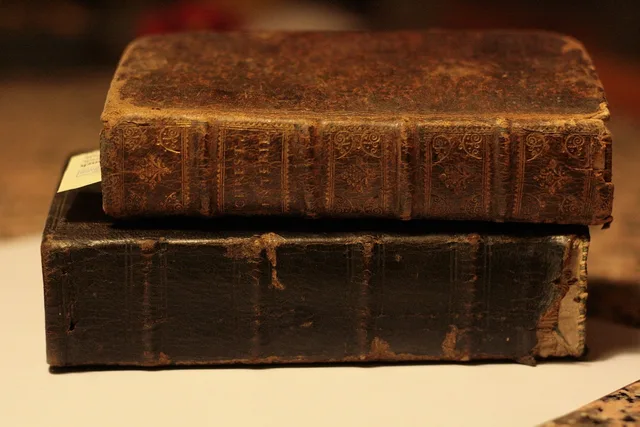
A conservator presses a thumbnail into a board edge rather than cutting it. Delamination, a soft core and a curled corner all show up in that one gesture. Board grade is recorded by name and calliper.
Chipboard and other board types vary widely in density, and the paperboard article on Wikipedia explains how those grades behave under load. A low density board that has absorbed moisture will keep warping inside a box.
Where a book may sit alongside federal publications, the U.S. Government Publishing Office style manual sets binding board requirements and names Davey board as the reference stock. Those expectations line up with bookbinding archival standards that most Canadian institutions share.
Sewing supports, thread and the spine lining
Support type is written down as cords, tapes, recessed cords or a hollow back. Thread fibre matters just as much. Linen, cotton and synthetic threads age at different rates and fail in different ways.
The Canadian Conservation Institute notes cover materials for bookbinding, including thread selection, which gives an inspector a dated reference for what a binder was likely to use.
A tight back that will not open flat is a handling problem, not a fault. Record the opening angle instead of forcing it.
Adhesives, pH and the handmade book condition report
Adhesive identification is done by look, feel and solubility. Starch paste, animal glue and PVA each leave a different surface. A tacky spine and a crystalline residue both go into the notes.
The report lists losses, stains, foxing, mould, insect damage and every earlier repair, with locations.
Adhesives, pH and report
| Element | What is recorded | Why it matters |
|---|---|---|
| Boards | Grade, thickness, warp | Sets the enclosure weight |
| Sewing | Support type, thread fibre | Predicts spine failure |
| Adhesive | Type and solubility | Guides any treatment |
| Paper | pH, foxing, staining | Sets handling rules |
A library special collections donation is reviewed on those same points, whatever the size of the gift. It also helps to read what Canadian archives expect before you describe your own copy, because intake forms often ask for the same categories in the same order.
Example: a quarter leather binding offered to a university library
Cover detached, sewing sound, boards warped, text paper pH 5.1, no active mould. Recommend a four flap folder and a drop spine box. Handle with a support.
That block of text is the shape of a usable assessment. It names the structural fault, clears the text block and gives the housing instruction.
Enclosures and archival box storage for books
Archival box storage for books usually means a four flap folder inside a drop spine box. Corner boards, unbuffered tissue for leather and buffered tissue for paper are standard choices. Measurements are taken at the largest point, not at the spine.
Storage conditions are quoted as ranges. Many Canadian facilities hold 18 to 21 degrees Celsius and 45 to 55 percent relative humidity, with light kept low. The practical detail is set out in What Library and Archives Canada and.