Guides
Part of Which error should decide your next bookbinding tool purchase?
A weekend of bookbinding tool drills: fifty cuts, fifty folds, a hundred piercings
Two days of bookbinding tool practice: fifty board cuts, fifty folds, a hundred piercings, ten sewn pamphlets and an overnight pressing comparison.
What to take away
- Two days on tool control alone, with no finished object at the end.
- Every session is one motion repeated until it stops being a decision.
- Cut, fold, pierce, sew, press. In that order, because errors propagate forward.
- Use scrap throughout. The point is the motion, not the material.
Saturday morning: the knife and the rule
Cut fifty strips of board, all the same width, all in single passes if the board allows and in several light passes if it does not.
- Hold the rule with your whole hand spread, not with fingertips.
- Keep the blade vertical and against the rule, not angled under it.
- Change the blade every fifteen or twenty cuts and notice the difference.
- Measure the last ten strips. Consistency, not the number, is the score.
By strip forty the knife stops being something you think about and becomes something your hand does, which is the entire objective of the session.
Saturday afternoon: the folder
Fold fifty sheets. Vary nothing except your attention. Then fold ten more with the folder held nearly flat, and ten with it held steeply, and compare the creases.
A folder held flat burnishes and produces a sharp, low crease. Held steeply it can score the sheet and cut the surface fibers, which shows up months later as a fold that has split. Knowing which of the two you are doing, and choosing it, is the whole skill.
Sunday morning: awl, needle and thread
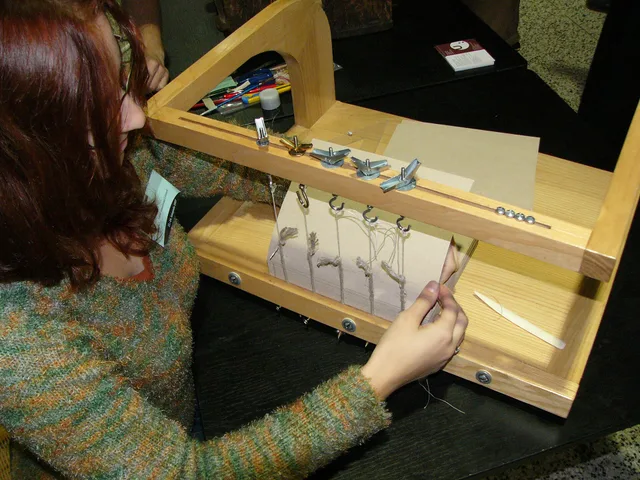
Pierce a hundred stations through folded scrap using a template, then sew ten pamphlets. Wax your own thread and notice how much wax is too much.
The measurable outcome is simple: the hole should be slightly smaller than the needle. Too large and the thread slides in the station and the sewing goes slack within weeks, whatever tension you used on the day. A hole that keeps its size is the first thing to check when a bookbinding symptom appears, before blaming thread or tension.
Sunday afternoon: the press
Press everything you made, all at once, and leave it overnight. Then compare a piece pressed for an hour against one pressed overnight.
Presses look ordinary because their ancestors were ordinary. The University of Edinburgh's exhibition material on early printing says productivity was extraordinary in printing's early years.
Gutenberg perfected mechanical movable-type printing in 1455, and Western Europe entered a printing revolution. Books were commissioned for personal and university libraries and for monasteries, which held the largest medieval collections.
The press behind that output was a modified screw press. Repeatable pressure is an old technology and it is still the least glamorous part of any bench.
Choose one structure to apply it to
Once the motions are automatic, pick a single structure and make it repeatedly. Cal Poly's guide to accordion and concertina bound books in its artists' books collection is a good starting point, describing accordion fold as a common form of binding that can be modified from simple to complex structures.
An accordion needs cutting, folding and pressing but no sewing, so it isolates three of the four skills you just practiced. The deliberate-error exercises are in projects that teach one skill through mistakes, and the tools involved are assessed in judging bookbinding tools.
Common questions
Fifty cuts sounds excessive. It takes about forty minutes and it is the difference between cutting carefully and cutting accurately. The two are not the same.