Reviews
Which error should decide your next bookbinding tool purchase?
No tools were bought or tested, so no ranking is given. A framework instead: survey first, judge by the error prevented, buy as failures appear.
What to take away
- No tools were bought, borrowed or tested for this article, so no ranking is offered and none should be inferred.
- Judge a tool by the error it prevents, not by the job it does.
- Survey what you own and what you actually make before buying anything.
- A press is a machine for applying even pressure, and that is the only specification that matters.
Why there is no tested ranking
The headline this article was drafted under promised results from practical testing. Testing tools honestly means buying several examples of each, using them over months on comparable work, and reporting what failed. That was not done here.
Writing a ranked list anyway, assembled from product descriptions, would read as testing and would not be. What follows is the judgment framework instead, which does not go out of date when models change.
Survey before you buy
Assessment before action is standard practice in collections work, and it transfers. The Park Service note on safe techniques for archival surveying and assessment describes what a survey produces: a report that describes each collection, summarizes legal and preservation risks, and identifies and prioritizes procedural, space and resource needs.
One-page survey before buying
- What you make
- How often you make it
- What fails
- What you already own
- Where the space runs out
Do the domestic version on one page. List what you make, how often, what fails, what you already own, and where the space runs out. Most tool purchases answer a question nobody asked.
Judge a tool by the error it prevents
| Tool | Error it prevents | Specification that matters |
|---|---|---|
| Straightedge | Joined and wandering cuts | Length, weight, non-slip back |
| Bone folder | Weak, air-trapped folds | Density and edge shape |
| Dividers | Uneven sewing stations | Pivot that holds its setting |
| Press | Waves and springing joints | Even pressure across the platen |
| Board shear | Out-of-square boards | Rigidity, not blade sharpness |
| Awl | Torn, oversized stations | Round point, right diameter |
Read the right-hand column before any review. If a product page does not answer it, the review will not either.
Tool versus error prevented
Tool
- Straightedge
- Wandering cuts
- Bone folder
- Weak trapped folds
- Dividers
- Uneven sewing stations
- Press
- Waves, springing joints
- Board shear
- Out-of-square boards
- Awl
- Torn oversized stations
Error prevented
- Straightedge
- Length, weight, non-slip
- Bone folder
- Density, edge shape
- Dividers
- Pivot holds setting
- Press
- Even platen pressure
- Board shear
- Rigidity, not sharpness
- Awl
- Round point, diameter
Spec that matters
- Straightedge
- Bone folder
- Dividers
- Press
- Board shear
- Awl
What a press is actually for
Presses look glamorous and are the most misunderstood.
The University of Chicago Library's exhibit text A Pressing Call is a useful reminder of where the machine came from. Gutenberg was a metalworker and innovator before he was a printer. He built on existing early fifteenth-century European presses for olive oil and wine, then modified them to print books and pamphlets.
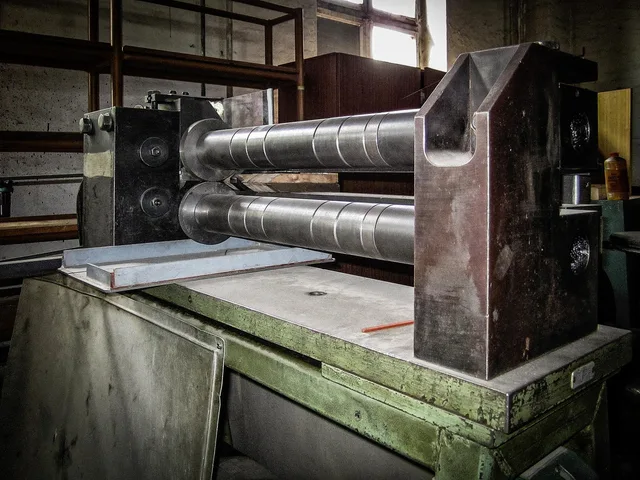
A press is a screw and a flat platen. What you are buying is evenness and repeatability, not force. A jack under a beam applies more force than most nipping presses and applies it far less evenly, which is why it makes worse books.
Buy in the order failures appear
Cutting errors first, folding second, sewing third, pressing fourth. That is the order faults appear in finished work. Buying in any other order equips you for problems you do not have yet.
The starting list is in a beginner tool kit for book arts. The surface those tools work on matters as much as the tools; it is covered in work surfaces for binding.
Common questions
Are expensive tools better?
Should I buy secondhand?
How do I test a press before buying?
Is a hobby-grade shear worth it?
In this guide
- Bookbinding machine access: questions to ask any studioBookbinding machine access, not lessons: the questions to ask before booking studio time, the search order to follow, and how to confirm hands-on use.
- Photographing bookbinding tools: raking light is what makes texture showShoot tools in use, light them at a raking angle for texture, and decide the file format and storage before you shoot rather than after a drive fails.
- Two tools can replace four: bookbinding categories compared for buyersCategories compared on the one specification that matters in each, plus the two tools that replace four and how printers solved small-tool storage.
- A weekend of bookbinding tool drills: fifty cuts, fifty folds, a hundred piercingsTwo days of bookbinding tool practice: fifty board cuts, fifty folds, a hundred piercings, ten sewn pamphlets and an overnight pressing comparison.
- Storing bookbinding tools means separate boxes for steel and organic stockHow to store materials used for bookbinding tools: steel wants dry, organic stock wants stable, and they should not share a box. Pest treatment, cavity packing.