Maintenance
Part of Book arts turns out to be four crafts sharing a single material
5 things worth knowing about book arts mistakes
The failures that repeat in home book arts work: grain, adhesive, damp storage and rushed pressing, and the cheap habits that prevent each one.
What to take away
- Nearly every home failure traces back to one of four causes: grain, moisture, adhesive, or impatience.
- A warped cover is almost never bad luck. It is board grain running the wrong way.
- Sealing damp or acidic work in plastic makes the problem worse, not slower.
- Mold needs moisture more than it needs dirt, so where you store work matters more than how clean it is.
Cutting before testing grain
The single most common mistake is cutting boards and endpapers to size before checking which way the grain runs. Testing costs nothing, and a wrong cut cannot be fixed afterward.
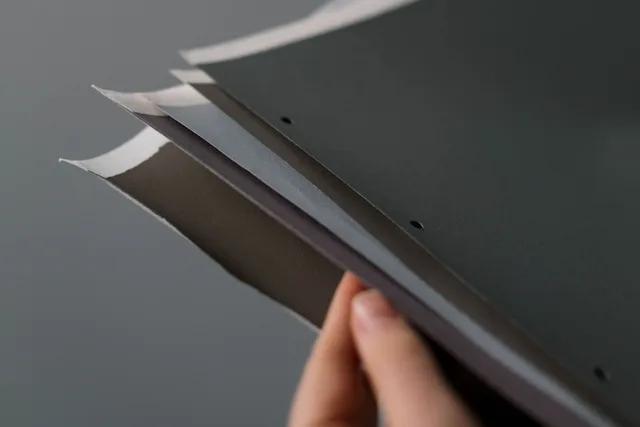
A cover cut across the grain will bow toward the pasted face as the adhesive dries and the board relieves tension unevenly. People then add more paste to the other side to counteract it, which adds more water, and the board cups harder.
Cut a strip from each new batch of board and paper. Mark the grain direction on the sheet in pencil before it goes on the shelf.
Using too much adhesive, too fast
Beginners flood glue because thin coats look inadequate. Thick PVA stays wet inside, swells the paper, and squeezes out at the turn-ins. Paste behaves worse: it carries far more water. Two thin coats, each pressed briefly, beat one heavy one every time.
Water is also why so many first covers cockle. Paper expands across the grain as it takes up moisture, and it shrinks again as it dries. If it is stuck down while swollen and dries under no restraint, it pulls the board with it.
Sealing work in plastic
Polyester sleeves feel protective, so people put fresh or fragile work straight into them. Park Service guidance on polyester encapsulation sets out two limits worth knowing.
The static charge that holds a fragile sheet in place will also lift friable media such as charcoal, pastel or flaking gouache. Early gelatin photographs should not go into polyester at all, because the emulsion can stick to the plastic or develop shiny patches.
The same instinct causes trouble with damp work. A sheet that is not fully dry, shut inside plastic, is a small humid chamber.
Storing where it is convenient rather than dry
Basements and garages are the default overflow space and the worst choice. The mold prevention leaflet explains why: fungal spores are already in the air, resist drying out, and sleep until they meet moisture.
Freezing deactivates spores but does not kill them, so a cold damp store only postpones the problem. Growth accelerates with warmth, poor air circulation, dim light and accumulated dirt.
Keep finished work in the part of the house you are comfortable living in. If a space feels clammy to you, it is wrong for paper.
Judging a book before it has dried
A book looks finished long before it is stable. Pull it from the press after an hour and the boards will move over the next week.
Leave it under weight overnight at minimum, and longer for anything with paste. A marbled or pasted sheet must dry flat under light restraint, or it will curl toward the coated side.
Most of these habits follow from the material choices made earlier, which is why choosing materials and the overview in book arts in 2027 are worth reading before a first project rather than after it.