Industry
Part of Book arts turns out to be four crafts sharing a single material
When does storage matter more to book arts than technique itself?
Book arts expert tips: storage, drying and studio layout decide more than technique does. What published guidance and studio equipment lists tell a first-year maker.
What to take away
- Storage matters more than technique when the binding is new and untested, when the volume is heavy, oversize or fragile, and when the room has no climate control.
- Storage habits, not technique, decide whether early work survives to be looked at later.
- Studio equipment lists are public, and reading one tells you what a serious setup actually needs.
- The skills that take longest to acquire are the boring onessquaring, measuring and waiting.
When storage beats technique
Storage outweighs technique in four situations, and every one of them turns on how hard the decision is to reverse.
- The binding is new and untested. A structure that sags in six months has told you something about the sewing that no photograph will, and the sag came from the shelf rather than the stitch.
- The volume is heavy, oversize or fragile. These go flat on shallow shelves, not upright, and finishing skill does not stop a heavy text block from pulling its own spine.
- The room has no climate control. Roughly 45 percent relative humidity at about 20 degrees Celsius is the target; a room that swings well past it ages a book faster than a mediocre sewing does.
- The layout cannot be changed later. Where wet work happens, and where boards and paper are kept flat, are harder to reverse than any tool purchase.
Turn those conditions around and technique is what the result depends on: an ordinary light book, in a room that holds its humidity, in a structure you have already made several times.
Preservation guidance for bound materials is public, and so is the equipment list of a teaching studio. Both describe rooms and shelves that already exist, which makes them cheaper to copy than a second attempt at a failed binding.
Shelving is a technique, not a chore
Most beginners store finished books the way they store paperbacks, and then wonder why spines sag within a year.
Shelving Rules for New Bindings
- Hold 45% relative humidity, 20C
- Never shelve books spine-side up
- Use full-size weight-bearing bookends
- Lay oversize or heavy volumes flat
- Sagging in six months means resew
The National Park Service Conserve O Gram on caring for bound materials is specific: roughly 45 percent relative humidity and about 20 degrees Celsius.
It warns against shelving books spine-side up and asks for full-size weight-bearing bookends, not small desk ones.
Oversize, fragile or heavy volumes go flat on shallow shelves, not upright.
The reason it matters to a maker is that your own bindings are new and untested. A structure that sags in six months has told you something about the sewing that no photograph will.
What a real studio actually contains
Equipment lists correct shopping-list thinking. The University of Iowa Center for the Book publishes its papermaking studio contents: a hydraulic press, a two-pound beater with a washer, a vacuum table, a Valley beater, and a standing screw press.
The same room holds a stack dryer, loft drying racks, and five vats. It also holds Western and Japanese molds capable of sheets up to three and a half by seven feet.
Two things become clear from that list. Most of the equipment handles water removal and drying — the storage half of the craft — not sheet forming. The parts a beginner fixates on, the molds, come last.
The habits that take a year to learn
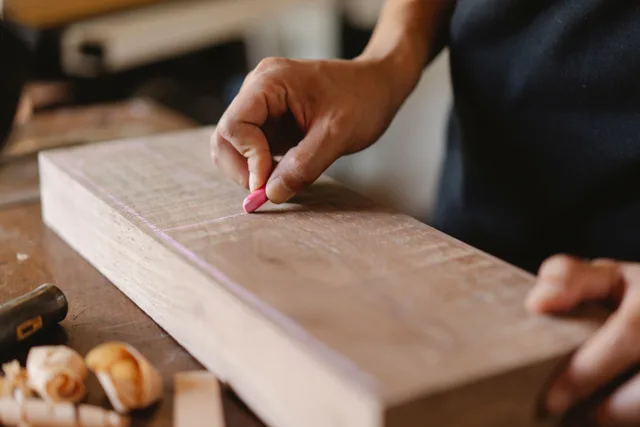
- Marking grain direction on stock the day it arrives, not the day you cut it.
- Cutting oversize and trimming to a line, instead of cutting to size and hoping.
- Writing down adhesive dilutions so a good result can be repeated.
- Letting things dry for longer than seems reasonable.
None of these is difficult. All of them are dull, which is why they are learned late.
What people underestimate about space
Bench depth matters more than bench area. You need room for a wet operation and a dry one at the same time, separated far enough that paste never reaches finished sheets.
Vertical storage for boards and paper, kept flat, takes more room than the working surface does. Where the book crafts diverge is worth reading before you commit a room to one of them, and a sequence of projects that teach one skill at a time is a cheaper way to find your own limits than buying equipment first.