Features
Part of Book arts turns out to be four crafts sharing a single material
6 book arts projects, each one built to teach a single skill
Six small book arts projects, each built to isolate a single skill: folding, sewing, casing, sheet forming, mounting and pressing to a flat result.
What to take away
- A project that teaches one thing is worth more than an ambitious project that teaches nothing clearly.
- Repeat each of these six times before moving on. The sixth is where the learning is.
- Two of them use no adhesive at all, which removes the largest variable early.
- Keep every attempt, dated and labeled, so you can see the change.
One: the folded signature, for accuracy
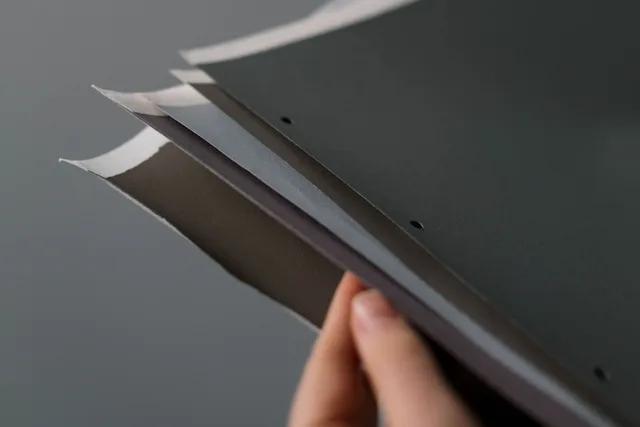
Take four sheets, fold each separately, nest them. Nothing else.
The skill is the fold: align corners before creasing, running the bone folder from the center outward to push air out rather than trap it, and keep creep at the fore edge even. Trim nothing. You learn four folded sheets do not stack flush, and why books need trimming.
Two: the three-hole pamphlet, for tension
The same signature, sewn with three stations. The skill is thread tension: firm enough that the sections do not gape, loose enough that the thread does not cut the fold. Use dividers to step the stations off equally rather than measuring each one, because equal spacing is easier to achieve by stepping than by ruler.
Three: a polyester film cradle, for measuring
Book supports made from film are a real bench exercise, not a toy. The Park Service describes a polyester film book support folded from one length into two wedges on a base. It fits small volumes roughly three to eight inches tall.
Measuring to the object, not a drawing, is the skill. It takes minutes, not an evening.
Four: pulling sheets, for consistency
If you have a mold and deckle, form twenty sheets from one vat and nothing else. The vocabulary alone is worth the session.
The Georgia Tech museum's hand papermaking glossary defines couching as transferring a newly formed sheet from screen to felt. It also defines the deckle as the removable frame that fixes sheet dimensions.
The skill is consistency. Sheets one to five come out thick and uneven. The vat thins as you work, so a sheet pulled last is lighter than one pulled first unless you charge the vat again.
Five: the single-section case, for squares
A cover made in two boards and a spine strip, cased onto a sewn pamphlet. The skill is the square: the even overhang of board beyond the text block on three edges, usually about three millimeters. Uneven squares are visible from across a room and are the clearest sign of rushed measuring.
Six: pressing, for patience
Not a project so much as a discipline. Take any finished item, press it properly, and open it a week later. Compare it against the one you pulled out after an hour.
pressing, for patience
- Boards between clean pressing boards, not against bare metal.
- Waste sheets against any damp surface, changed once.
- Even weight across the whole area, not a single heavy object in the middle.
- A note of the date, so you stop guessing how long things took.
Work through these in order and the tool list in a beginner tool kit will make sense, because you will have used every item on it. The wider map is in the book arts overview.