Reviews
Part of Book arts turns out to be four crafts sharing a single material
What actually separates good book arts materials: pH, lignin or grain?
How to choose materials for book arts in 2027: paper, board, cloth, thread and adhesive judged on the properties that matter, pH, lignin, grain.
What to take away
- Five properties decide almost every material questionpH, lignin content, grain, weight and reversibility.
- Acid-free is a floor, not a specification. Ask whether the stock is buffered as well.
- Buffered is not automatically better; for some materials an unbuffered neutral enclosure is the safer default.
- Cheap practice stock is a good idea, and it should never end up inside finished work.
Read the pH claim properly
Suppliers use acid-free loosely. The National Park Service note on buffered and unbuffered storage materials gives the numbers behind the phrase.
A buffered sheet carries an alkaline reserve that neutralizes acids as they form, and that reserve depletes. A box bought acid-free in 2010 may not be acid-free now. When the object type is unclear, the same note recommends unbuffered neutral.
Lignin decides lifespan, not cost
Lignin is the tree component that makes mechanical pulp cheap and short-lived. National Park Service guidance on judging permanence for paper and inks puts contemporary groundwood paper at a life of fifty years or less, and specifies lignin-free high alpha-cellulose paper at pH 7.5 to 8.0 for records meant to last.
For a maker this translates into one shopping habit. Look for lignin-free and high alpha-cellulose on the label. Mohawk Superfine in a text weight, sold as archival and lignin free, is one example worth buying for work you keep. If neither phrase appears, treat the stock as practice material. Check the mill spec sheet, because lines change.
Weight, grain and format
| Component | What to check | Common error |
|---|---|---|
| Text paper | 90 to 120 gsm, grain short | Buying by color, not weight |
| Board | 1.5 to 2.5 mm, grain head to tail | Chipboard from a craft store |
| Cloth | Paper-backed, not raw fabric | Adhesive bleeding through |
| Thread | Linen, 18/3 to 30/3 | Thread too thick for the section count |
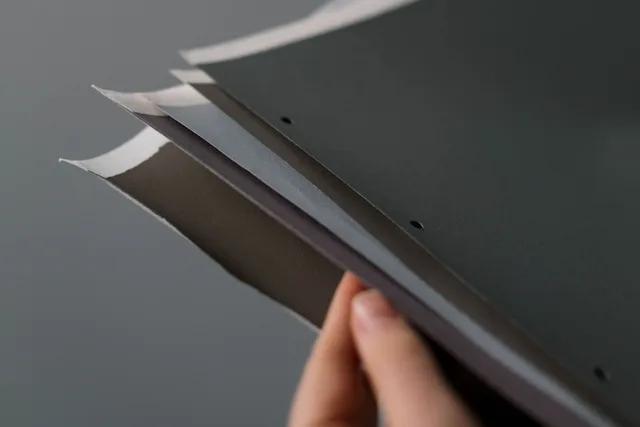
Grain short means the grain runs parallel to the short edge of the sheet, which is what you want for a book taller than it is wide. Ask the supplier; good ones state it.
Adhesives and the reversibility question
PVA is flexible, fast and effectively permanent. Wheat starch paste is slow, water-bearing and reversible with moisture. Methyl cellulose sits between them and is often mixed with PVA to slow it down and improve reversibility.
Reversibility is not a moral position. It is a practical choice about whether a future repair is possible without destroying the sheet. On anything you might want repaired, use paste or a paste mix. On a bookcloth turn-in that will never be undone, PVA is the sensible option.
A short buying order
- One pack of good text paper in a single format, so you learn one sheet well.
- Board in one thickness, cut oversize.
- Linen thread in a single size and a block of beeswax.
- One adhesive, learned properly, before you own three.
That sequence keeps variables down while you are still making the errors described in common beginner mistakes. The wider picture is in the book arts overview.