Guides
Book arts turns out to be four crafts sharing a single material
Book arts is four crafts sharing one material. How binding, papermaking, printing and paper decoration fit together, and what to learn first.
What to take away
- Book arts is an umbrella over four crafts sharing one material: binding, papermaking, printing, decoration.
- Grain direction ruins more first projects than any shortage of tools does.
- Paper you buy today is chemically unlike paper in a pre-1850 book, which changes how you store what you make.
- A bone folder, a sharp knife, a steel rule and a needle will carry you through a first year.
What the term covers
The phrase gets used loosely, which is why beginners buy the wrong thing first. Underneath it sit four trades with different vocabularies and failure modes. Binding assembles folded sheets into something that opens and closes. Papermaking forms sheets from beaten fiber suspended in water. Printing puts ink on those sheets. Decoration patterns the surface, usually by marbling or paste.
Four trades, one material
Binding
- First project
- Three-hole pamphlet
- Fiddly part
- Grain, spine swell
- Does what
- Assembles sheets
Papermaking
- First project
- Cotton linter sheets
- Fiddly part
- Even formation
- Does what
- Forms sheets
Printing
- First project
- Lino block
- Fiddly part
- Ink tack, register
- Does what
- Puts ink on
Decoration
- First project
- Paste paper
- Fiddly part
- Bath, drying curl
- Does what
- Patterns surface
They meet in a finished book and almost nowhere else. Deciding which of the four you want is the most useful thing you can do in week one.
| Trade | First real project | Where it gets fiddly |
|---|---|---|
| Binding | Three-hole pamphlet | Grain, spine swell, warped boards |
| Papermaking | Cotton linter sheets | Even formation, drying flat |
| Printing | Lino block on smooth stock | Ink tack, register, offsetting |
| Decoration | Paste paper | Bath consistency, drying curl |
Grain direction comes before everything
Machine-made paper and board have grain: fibers lie mostly one way. Paper folds cleanly along the grain and fights you across it.
In a book, the grain of every sheet, every board, and the covering cloth must run head to tail, parallel to the spine. Get it wrong and the book will not open properly, the covers bow once paste dries, and pages ripple at the fore edge.
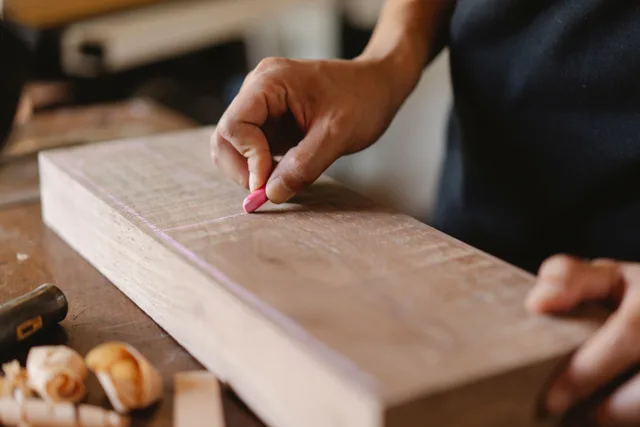
Test before you cut. Tear a scrap: the straight tear runs with the grain. Or flex the sheet both ways without creasing it and feel which gives less resistance.
The paper problem you inherited
Paper made before roughly 1850 was mostly cotton and linen rag, long-fibered and close to neutral. The National Park Service leaflet on acidic wood pulp paper sets out what changed: alum arrived around 1806 to precipitate rosin sizing onto the fibers, and ground wood pulp followed mid-century.
Lignin left in mechanical pulp darkens and breaks down into acidic byproducts as it ages, so groundwood paper is acidic from the day it is made. Bind on cheap cartridge, line the boards with newsprint, and that acid migrates into whatever it touches.
Where the four crafts sit in one book
The Robert C. Williams Museum of Papermaking at Georgia Tech, founded in 1939 by paper historian Dard Hunter, now holds more than 100,000 artifacts. It is built around this point: paper is the substrate the other trades depend on.
Open an old cased book and all four decisions are visible at once. The text paper carries the printing, the endpapers are decorated stock, and the sewing and board attachment are the binder's work.
A sensible order to learn in
- Fold and sew pamphlets until the stitches sit straight and the fold is sharp.
- Learn grain testing on scrap, then cut boards for a single-section case.
- Make paste paper before marbling, because the bath is easier to control.
- Add printing last, since it multiplies every mistake in the other three.
Skipping ahead is normal and mostly costs materials. The beginner tool kit for book arts is short, and the questions in choosing materials matter more than the tool list.
Common questions
Do I need a press to start?
Is PVA or wheat starch paste correct?
How much does paper weight matter?
Can I practice on printer paper?
In this guide
- 6 book arts projects, each one built to teach a single skillSix small book arts projects, each built to isolate a single skill: folding, sewing, casing, sheet forming, mounting and pressing to a flat result.
- When does storage matter more to book arts than technique itself?Book arts expert tips: storage, drying and studio layout decide more than technique does. What published guidance and studio equipment lists tell a first-year maker.
- The tools that actually earn bench space in book arts, and what can waitThe short list of tools that actually earn bench space in book arts, what each one is for, where to spend, and which purchases can wait until year two.
- What actually separates good book arts materials: pH, lignin or grain?How to choose materials for book arts in 2027: paper, board, cloth, thread and adhesive judged on the properties that matter, pH, lignin, grain.
- 5 things worth knowing about book arts mistakesThe failures that repeat in home book arts work: grain, adhesive, damp storage and rushed pressing, and the cheap habits that prevent each one.