Guides
Part of 4 points on handmade journal ideas that matter
Folding compared with sewing: a weekend plan for handmade journals
Handmade journal ideas learning plan: four sessions over two days, fold twenty sheets, sew five identical pamphlets, cover them without metal fasteners.
What to take away
Folding and sewing both end up in a handmade journal, and they fail in different ways.
- Two days, four sessions, one structure. The point is repetition, not variety.
- Saturday is folding, then sewing. Sunday is covers and an enclosure.
- Sewing adds an awl, needles and waxed linen thread, and takes longer than folding.
- Make five of the same journal rather than one of five kinds.
- End by testing how each one opens, because that is the only honest verdict on the sewing.
Before Saturday: cut everything
Spend twenty minutes the night before cutting stock, so no session starts with measuring. For five pamphlets of four sections you need twenty folded sheets, five covers, thread, and a waste sheet or two. Mark grain direction on every piece as you cut it, because you will not remember on Sunday.
Bookbinding linen thread is sold by number, commonly 18/3 and 25/3, and the lower number is the heavier thread. A block of beeswax, a few dollars at most, keeps linen from tangling.
Set out the tools you will use and nothing else. A cluttered surface is how blades end up under paper, and how a wet brush ends up on a finished cover.
Saturday morning: folding, the half with no thread
Fold all twenty sheets. Do not sew anything.
Saturday morning: folding
- Align the far corners first, then bring the near edge over.
- Crease from the center outward with the folder held almost flat.
- Set each folded sheet aside under a light weight.
By sheet fifteen the folds will be visibly better than sheet one. That is the entire lesson, and it is why you fold twenty rather than four.
Folding is the cheap half. A bone folder, the flat tool that presses a crease, runs typically $6 to $20.
A bone folder creases and burnishes paper, and leaning on it can crush a fold. That matters because a crease is permanent, while stitching can be undone with a knife.
Saturday afternoon: sewing, the pamphlet stitch
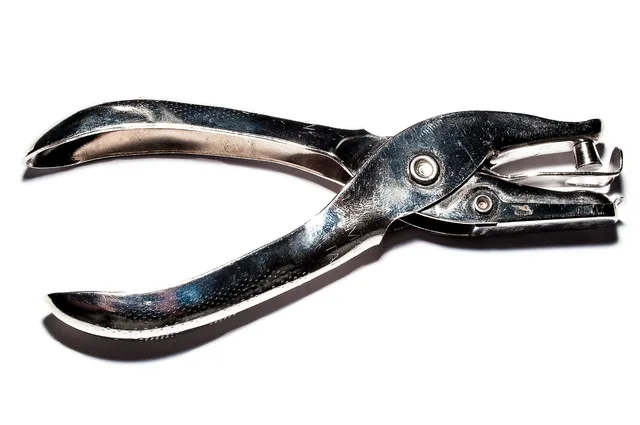
Sew all five pamphlets. What you are sewing is the pamphlet stitch, the simplest sewn structure in bookbinding. Three or five holes punch through the fold, and the ends tie inside the middle.
Use dividers to step the stations rather than measuring each. Aim for the same tension every time: firm enough to close the sections, loose enough that the thread does not bite the fold.
Work through all five without stopping to admire them. Stopping breaks the rhythm the repetition builds, and by the last two you are working from hand memory rather than instructions.
When you finish, compare the first and fifth spine. A tighter, straighter fifth spine means the practice worked. A worse one means rushing, which is also useful to know.
Sewing holds together sections that folding alone leaves loose. The kettle stitch links one section to the next at the head and tail, which is how a multi-section book holds on tapes.
The Coptic stitch chains the sections to one another and to the boards, so the finished book opens flat. Japanese stab binding, yotsume toji in the four-hole version, punches through the side of the whole block instead of the fold.
Sunday morning: covers and fastenings
Cover the blocks. Half the interesting decisions in a journal are about how it stays shut: a wrapped cover, a tie, an elastic, or a flap.
A tie wants linen tape, which knots better than ribbon. For a rigid cover, the standard board in the US is sold as Davey board.
Avoid metal; the Park Service note on attachments for multi-page documents sets out preferred alternatives to fasteners.
A folded sheet of archival bond paper wrapped widthwise around the related sheets as an interleaving folder tops the preference list.
Several common fastening methods are not recommended; paper clips and staples rust into paper, and the stain does not come out. Hinge repairs often use Tyvek, a spunbonded polyethylene sheet that does not tear along the fold.
Sunday afternoon: test how they open
Finish by cutting a simple wedge cradle from board and setting each journal into it in turn. A journal that will not stay open, or strains at the fold, tells you about the sewing no photograph will.
Cutting the cradle takes about an hour. It teaches measuring to an object rather than to a drawing.
Folding faults look different. A sheet that rocks or a section out of square points back to the crease, not the thread.
Home makers eventually meet the limit of home work, and the University of Michigan Library's preservation services page describes that division of labor.
Staff send selected books to contract vendors for binding or deacidification, while specialists handle other material on site in a conservation lab.
The department advises the library on storage environments, handling, display and disaster recovery.
Common questions
What if I only have one day?
Should I use good paper?
Five identical journals seems wasteful. They are not identical by the end. Keep them in order and dated; the sequence is the record of what you learned. The formats in eleven journal ideas are all easier once one structure is solid.